Warehouse Equipment Guide: Pallet Trucks, Reach Trucks and Order Pickers Explained
The Short Answer
Use powered pallet trucks for ground-level horizontal moves and truck loading, reach trucks for putting pallets into racking above about 3 metres in narrow aisles, and order pickers when staff pick individual cartons from racking rather than moving full pallets. Most warehouses run a mix: pallet trucks on the dock, reach trucks in the racking, and order pickers in the pick face.
Powered pallet trucks: the dock workhorse
Walkie and ride-on pallet trucks move pallets horizontally — off trucks, across the floor, into staging lanes. Entry-level walkie models like the Bobcat LPM15N/LPM20N suit lighter duty, while ride-on models such as the BPR20N/BPR25N keep operators productive over longer travel distances.
- Lift height: ground clearance only — these are not stacking machines
- Capacity: typically 1.5 t to 2.5 t
- Choose ride-on models when travel runs exceed ~30 metres
Reach trucks: high racking in narrow aisles
Reach trucks are built for one job: putting pallets into racking, high and tight. The mast reaches forward to deposit the pallet, so the truck itself stays compact — working in aisles far narrower than a counterbalance forklift needs. Bobcat's 9-Series reach trucks handle 1.3 t to 2.5 t and reach the top levels of most Australian racking installations.
- Aisle width: from roughly 2.7 m, versus 3.5 m+ for a counterbalance forklift
- Every 300 mm of aisle saved adds a surprising amount of racking capacity
- Electric only — reach trucks are indoor machines on smooth floors
Order pickers: cartons, not pallets
When your operation picks individual cartons or items from racking, an order picker lifts the operator up to the stock. High-level models like the Bobcat BOP15S-9 take pickers to upper rack levels safely, replacing ladders and dramatically speeding up each pick.
Matching the machine to your warehouse
Racking height, aisle width and pick profile decide the fleet, not brand brochures. Send us your warehouse layout and we'll spec the right mix — call 03 7053 2937 or request a quote.
- Full pallets in and out at ground level → powered pallet truck
- Full pallets into racking above 3 m → reach truck
- Individual carton picks from racking → order picker
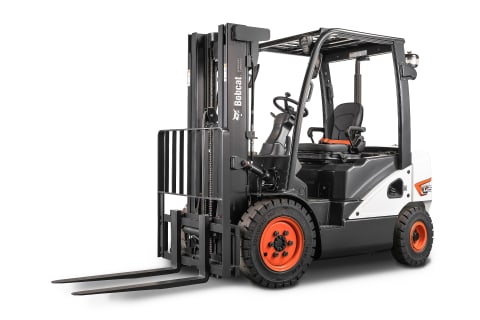
- Mixed yard and warehouse work → electric or LPG counterbalance forklift
Frequently Asked Questions
What is the difference between a reach truck and a forklift?
A reach truck extends its mast forward to place pallets in racking, so the machine stays short and works in aisles as narrow as about 2.7 metres. A counterbalance forklift carries the load on its forks ahead of the machine and needs wider aisles, but can work outdoors and handle heavier loads.
How narrow can warehouse aisles be with a reach truck?
Most reach trucks operate in aisles from roughly 2.7 metres wide, compared with 3.5 metres or more for a counterbalance forklift. Narrower aisles mean more racking in the same floor area.
Do warehouse forklifts need a licence in Australia?
Counterbalance forklifts and order pickers require a high-risk work licence (LF class for forklifts, LO for order pickers) in all Australian states. Pedestrian-operated pallet trucks generally do not require a licence, but operators must be trained.
Need help choosing the right equipment?
Our team specs Bobcat equipment for Australian businesses every day. Get expert advice and a fast quote.